
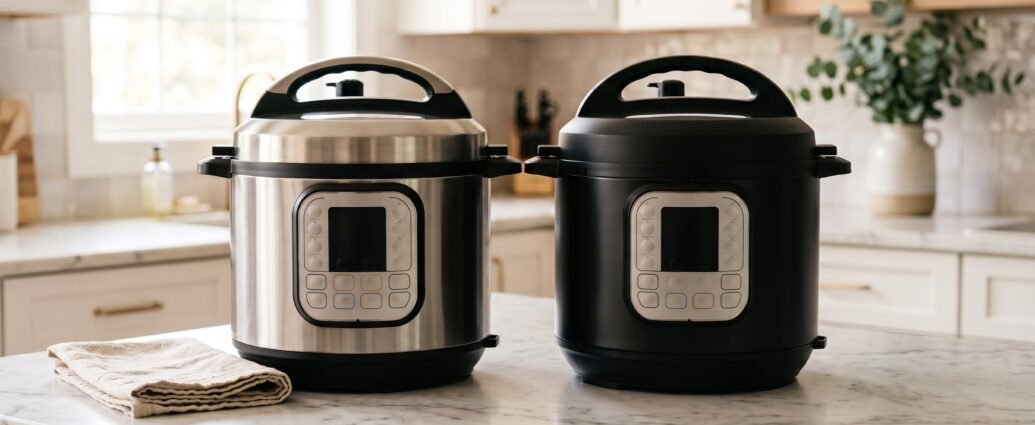
Heads up: The Kitchen’s Aid is a participant in the Amazon Services LLC Associates Program. If you buy through a link on this page, I may earn a small commission at no extra cost to you. It doesn’t change what I tell you.
The short answer
Buy the Duo unless one of three specific things is true for you. Get the Pro if the steam release noise genuinely bothers you, if you sear meat before pressure cooking on a regular basis, or if you’ll actually use sous vide. Otherwise the Duo cooks the same food, and the difference is refinement rather than capability.
I should tell you where I’m standing: I own the 6-quart Pro. I don’t regret buying it. I’m still telling most people to buy the Duo, and I’d rather explain why than pretend the more expensive pot is the right answer for everyone.
| Duo 7-in-1 | Pro 10-in-1 | |
|---|---|---|
| Pressure cooking | Identical | Identical |
| Steam release | Loud, jets upward | Quieter, diffused |
| Inner pot | No handles, not stovetop-safe | Grip handles, stovetop-safe |
| Sous vide | No | Yes |
| Custom programs | No | Yes, saveable |
| Preheat speed | Slower | Faster |
| Owner rating | 4.7★ · 173,500+ | 4.5★ · 14,000+ |
| Typical gap | — | About $50–60 more |
Check the Duo on Amazon → · Check the Pro on Amazon →
Ratings pulled from Amazon on August 24, 2026.
How I compared these
I own and cook in the 6-quart Pro most weeks, so the Pro half of this comparison comes from actually using one. I have not owned a Duo. For that side I relied on published specs, the feature differences Instant Pot itself documents, and owner reviews at a scale that’s hard to argue with — the Duo has over 173,000 ratings, which tells you far more than a handful of hands-on impressions would.
Where the two pots differ, the differences are concrete and documented, not subjective. That’s what makes this an easy comparison to make honestly.
What’s actually the same
Start here, because it’s the part the marketing buries.
The cooking is identical. Both pots reach the same pressure and hold the same temperatures. A pot roast, a batch of dried beans, or a pound of rice comes out exactly the same from either machine. There is no recipe that works in one and fails in the other, and no dish that tastes better from the Pro. If you were hoping the extra money buys better food, it doesn’t.
The capacity options are the same. Both come in 6-quart and 8-quart. The 6-quart is right for most households — see the sizing breakdown in my full Instant Pot comparison if you’re unsure.
Both run the same accessories. Sealing rings, steamer baskets, springform pans — same sizes, same fit.
So everything below is about the experience of using the pot, not the results that come out of it. That’s a real distinction and it’s the one that should drive your decision.
What’s genuinely different
1. The steam release — the big one
This is the difference that matters most day to day, and it’s the one people underestimate before buying.
The Duo’s quick release sends a hard vertical jet of steam straight up. It’s loud, and if you have a low cabinet or a microwave above the counter, the steam hits it. Owner reviews are extremely consistent on this point; it’s the single most common complaint about the Duo, and it’s the reason the Pro’s redesigned release exists.
The Pro diffuses the steam rather than jetting it. It’s meaningfully quieter and it doesn’t blast your cabinets. I do a quick release most times I cook, and I’ve never had to think about where the pot is sitting.
Does it justify the price on its own? For some people, honestly, yes. If your kitchen is open to a living room or a bedroom, or you cook late in the evening, this one feature is the whole argument.
2. The inner pot
The Pro’s inner pot has grip handles. This is the feature I noticed least when buying and appreciate most since — you lift the pot out one-handed without hunting for a towel or oven mitt. Small, constant, and you feel it every single time.
It’s also stovetop-safe, so you can start a sear on the burner and move the whole pot over, or finish a sauce on the stove after pressure cooking. The Duo’s pot is not stovetop-safe, so searing happens in the machine on Sauté mode — which works, just less well, because the sauté heat is less even and less hot than a burner.
Who this actually matters to: people who brown meat before pressure cooking. If you make a lot of pot roast, short ribs, chili, or anything that starts with a sear, this is worth real money. If you mostly dump ingredients in and hit start, it’s worth nothing.
3. Sous vide and custom programs
The Pro adds sous vide, and it works. Be honest with yourself about whether you’ll use it — most people who buy a multi-cooker partly for sous vide use it a handful of times and then go back to the oven. It is not a reason to spend more unless you already sous vide with something else and want to consolidate.
The saveable custom programs are the quieter win. Set your regular cook once, save it, and stop re-entering time and pressure every time you make the same thing. It’s a genuine small pleasure if you cook the same handful of dishes on repeat.
4. Preheat speed
The Pro comes to pressure faster. It’s a real difference, but it’s minutes, not a transformation — don’t let it decide anything on its own.
Where the Duo wins
Not everything favors the more expensive pot, and two of these are more important than they look.
Price. The Duo typically runs about $50–60 less. For a first pressure cooker, that gap is the difference between “I’ll try it” and “I’d better use this to justify it.” Buying the cheaper pot and discovering you love pressure cooking is a much better outcome than buying the expensive one and finding it lives in a cabinet.
It’s the default everything is written for. Recipes online — including the 140-plus on this site — assume a 6-quart Duo unless stated otherwise. This mostly doesn’t matter, since the pots cook the same, but the Duo is the reference point and there’s a small comfort in that when you’re new.
Simplicity. Fewer buttons, fewer modes, less to learn. For a nervous beginner, the Duo’s plainness is a feature.
Track record. 173,000-plus ratings at 4.7 stars is an extraordinary amount of evidence that a product holds up. The Pro’s 4.5 across 14,000 is good, but it’s a fraction of the sample.
So which one should you buy?
Buy the Duo if this is your first pressure cooker, you’re price-sensitive, you mostly dump-and-start, or you’re not yet sure how much you’ll use it. This is most people. You can always upgrade later, once you know your own habits — and if you do, you’ll know exactly which features you’re paying for.
Buy the Pro if the noise is a real problem in your kitchen, you sear before pressure cooking regularly, you’ll genuinely use sous vide, or you already know you’ll be cooking in it several times a week for years. That last one is the case I bought into, and on those terms the refinement pays for itself.
Don’t buy the Pro because it has more numbers in its name. Ten-in-one versus seven-in-one is marketing arithmetic. The three functions that separate them are sous vide, sterilize, and cake, and most owners of either pot use exactly none of them.
Frequently asked questions
Does the Pro cook faster than the Duo?
It preheats faster, so total time is slightly shorter. Once both are at pressure, cook times are identical — you don’t adjust recipes between them.
Is the Instant Pot Pro worth the extra money?
If you cook in it several times a week and the steam release noise or searing matters to you, yes. If you’re buying your first one or you dump-and-start, the extra money buys refinement you may not notice.
Can I use Duo recipes in a Pro?
Yes, with no changes at all. Same pressure, same cook times, same liquid minimums.
Which is better for a beginner?
The Duo. Fewer controls, lower price, and it’s the model recipes are written around. Nothing about it will confuse you.
What about the Duo Plus — where does that fit?
The Duo Plus sits between them, adding a much better progress display to the Duo’s basics. It often costs about the same as the Pro, which is an awkward spot. If you’re spending Pro money, the Pro’s stovetop-safe pot is worth more than a screen.