
Heads up: The Kitchen’s Aid is a participant in the Amazon Services LLC Associates Program. If you buy through a link on this page, I may earn a small commission at no extra cost to you. It doesn’t change what I tell you.
The short answer
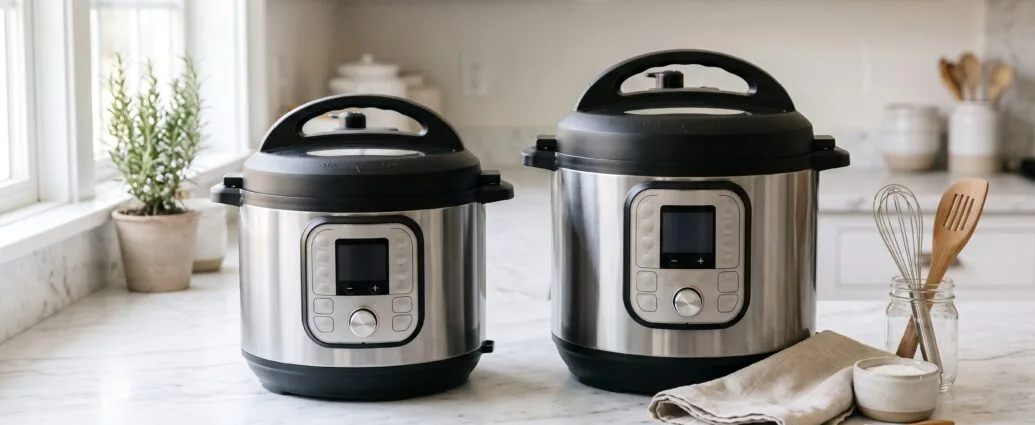
Get the 6-quart. It’s the right size for one to five people, it’s the size every recipe online is written for, and it’s the lower-regret choice if you’re torn.
Mine is a 6-quart, and after cooking in it for years I’ve never once wished it were bigger. That’s the honest headline, and most articles on this question dance around it because “it depends” is easier to write.
Get the 8-quart only if you have a specific, recurring reason — batch-cooking for the freezer, feeding six or more regularly, or making big pots of stock. “Just in case” is not one of those reasons, and I’ll explain why below.
There’s also a catch nobody mentions: going to 8 quarts may force you into a more expensive model than you wanted. More on that in a moment, because it’s the part that actually changes decisions.
How I compared these
I cook in a 6-quart Instant Pot Pro most weeks, so the 6-quart half of this comes from genuine long-term use. I don’t own an 8-quart. For that side I’ve relied on documented specifications, current Amazon listings, and the consistent patterns in owner reviews rather than pretending to a side-by-side test I didn’t run.
The trade-offs here are mostly physics, though, which makes this an easier question to answer honestly than most. More volume means more air and liquid to heat. That isn’t a matter of opinion.
What 6 quarts actually holds
Numbers on a box don’t mean much, so here’s what fits:
- A 4-pound pork shoulder, whole, no trimming to fit
- A whole chicken up to about 4 pounds
- A double batch of chili or soup — roughly 6 to 8 servings
- A full pound of dried beans, which yields a lot of beans
- 8 to 10 cups of cooked rice
For a household of one to five, that’s not “adequate,” it’s comfortable. The reason the 6-quart is the default isn’t cost-cutting — it’s that it genuinely covers the range of cooking most people do.
Worth knowing: you can never fill any pressure cooker more than two-thirds full, and only half full for foods that foam and expand like beans, rice, and pasta. So a 6-quart is really a 4-quart working volume, and a 8-quart is really about 5.3. That constraint applies to both, and it’s the number that actually matters.
When the 8-quart is genuinely the right call
Four situations, and they’re all about repetition rather than capacity:
You batch-cook for the freezer. If Sunday means making four meals at once, the extra room converts directly into fewer cooking sessions.
You regularly feed six or more. Not holidays — regularly. A big family, or a household that always has people at the table.
You make stock. Bones take up an absurd amount of space for the liquid they yield. This is the single best argument for 8 quarts.
You cook large cuts. A 5-pound-plus roast, a big brisket, a large whole chicken with room for liquid around it.
If two or more of those describe you, get the 8-quart and don’t second-guess it.
The four real trade-offs
It takes longer to come to pressure
More air and more liquid to heat means a longer preheat. This is not a small tax — it applies to every single thing you cook, including the small ones. The “10-minute dinner” gets slower in the bigger pot even when you’re cooking the same amount of food.
Small batches come out worse
Every pressure cooker needs a minimum amount of liquid to generate steam, and the 8-quart’s minimum is higher. Cook a small recipe in a big pot and you’re forced to add more liquid than the recipe wants — which means thinner sauces, more diluted flavor, and reducing afterward.
This is the trade-off people don’t anticipate, and it’s the strongest argument against buying big “just in case.” A too-small batch in a big pot is a real, recurring annoyance. A full 6-quart is just dinner.
It’s tall
Measure the gap between your counter and your upper cabinets before you buy. The 8-quart needs clearance to open the lid, not just to sit there. A lot of people discover this after the box is open, and it’s how pots end up living on the floor of a pantry.
It’s heavier
Empty, it’s more to lift. Full of stock, it’s a genuinely two-handed job. If you’ll be moving it in and out of a cabinet rather than leaving it out, this matters more than it sounds.
The catch: 8 quarts limits your model choices
This is the part I’d want to know before shopping, and it’s not in most articles on this question.
When I checked Amazon on August 24, 2026, the base Duo — the cheapest way into a real Instant Pot, and my overall pick — was listed in 6-quart and a 3-quart Mini. The 8-quart options were all step-ups:
- Duo Plus 8-quart — the mid-tier model
- Pro 8-quart — the premium one, and noticeably pricier than the 6-quart Pro
- Duo Crisp 8-quart — the air fryer combo
- RIO Wide 7.5-quart — a newer wide-base design with a quieter steam release
So “I’ll get the 8-quart” often quietly means “I’ll spend more than I planned,” because you’re not just buying more volume — you’re buying a different tier of machine. Availability shifts, so check for yourself, but budget for the step-up rather than assuming the size upgrade is a small surcharge.
Check 6-quart Duo pricing on Amazon → · Check 8-quart Duo Plus pricing →
What about 3-quart and 4-quart?
Worth a brief mention, because sometimes the answer to “6 or 8” is actually “neither.”
If you cook for one or two people, a 3-quart Duo Mini or 4-quart RIO Mini is lighter, easier to store, and cheaper. The honest catch is that most recipes online are written for 6-quart, so you’ll be halving things constantly — and liquid minimums don’t scale down as cleanly as you’d like. It’s a real trade for real convenience. If more than two people eat at your table, skip it.
The bottom line
If you’re genuinely torn, buy the 6-quart. It’s not a compromise — it’s the size the whole ecosystem is built around, it costs less, it heats faster, it fits under your cabinets, and it opens up the cheaper models.
The failure mode for buying too small is occasionally cooking in two batches. The failure mode for buying too big is a slower, thinner, heavier pot you use every single day. Those aren’t equivalent risks.
Frequently asked questions
Is the 8-quart Instant Pot too big for a family of four?
For most families of four, yes — the 6-quart handles a family-of-four dinner comfortably. Go 8-quart only if you batch-cook for the freezer or make stock regularly.
Do I need to change cook times between a 6-quart and an 8-quart?
No. Pressure cook times are identical. The 8-quart takes longer to reach pressure, so total elapsed time is longer, but the cook time you enter doesn’t change.
Can I make small recipes in an 8-quart?
You can, but the higher minimum liquid means small batches often come out thinner. It’s the most common regret among people who sized up unnecessarily.
Which size do most Instant Pot recipes assume?
6-quart. Unless a recipe says otherwise, that’s what it was written for — including the 140-plus Instant Pot recipes on this site.
Is a bigger Instant Pot harder to clean?
Not harder, just bulkier. The inner pot is heavier to lift and more awkward in a sink.